


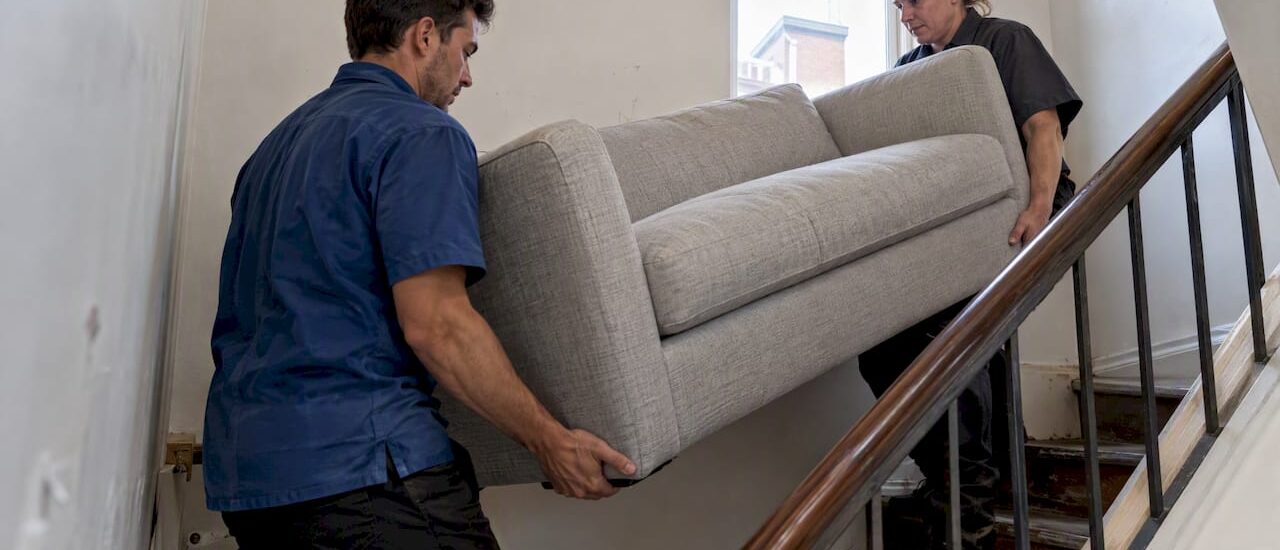
The safest way to get a heavy piece of furniture upstairs is to measure the item and the staircase first, strip the route of obstacles, protect the piece with blankets and straps, then use the right aid for the job. If the measurements don’t leave clearance, or the item is oversized or awkward to hold, book professional removalists rather than force it.
TL;DR:
- Solo moves are reasonable only for compact pieces under roughly thirty kilograms with low centers of gravity; stop if visibility or balance becomes uncertain.
- Keep loads close to your body and control pushing or pulling; awkward posture and reaching raise injury risk more than weight alone.
- For heavy furniture, assign a lead, a tail, and a spotter, agree on lift, stop, and turn commands, then rotate together at landings.
- Use sliders on landings, not stair treads, and choose a stair dolly only when the riser heights and tread width suit its wheels.
- Book professionals if an item shifts unpredictably, blocks your view, or cannot turn safely on a landing; damaged or uneven stairs warrant expert help.
A stair move goes wrong long before anyone lifts anything, usually because nobody measured first. Pull together your gear and run the checks below before you touch the furniture.
You’ll want:
Measure the furniture’s height, width and depth, then measure the staircase: width, riser height, headroom at any bulkheads, and the clearance on each landing. Check doorways along the route too, since a piece that clears the stairs can still jam at a frame. Walk the whole path and remove rugs, shoes, pot plants or anything else that could cause a trip. Switch on hall and stairwell lights, since a dim stairwell hides the exact moment a corner gets too tight. WorkSafe Victoria treats moving large or awkward furniture on stairs as high-risk and recommends assessing the path’s gradient, surface condition and width before anyone attempts the lift.
Keep a basic first-aid kit nearby and a phone charged in case of a slip or a pinched finger.
Pro Tip: Photograph the full route, including both landings, before you move anything, following this Move-In and Move-Out Inspection Guide for Landlords to ensure thorough documentation. It’s the fastest way to spot a pinch point you’d otherwise discover halfway up the stairs.*
Not everything needs two people, but plenty of items that look manageable solo aren’t. A reasonable rule of thumb is that compact pieces under roughly thirty kilograms with a low centre of gravity, a bedside table, a small bookshelf, a dining chair, are fair game for one person. A kitchen hutch, a queen mattress or anything that shifts its weight unpredictably when tilted is not.
Signs you should stop and call for help: the item blocks your view of the steps ahead, it tips unpredictably when you tilt it, or you’re bracing it with your back rather than your arms and legs.
For items that are within solo range, work through this sequence:
Throughout, control the horizontal push or pull force rather than focusing purely on the item’s weight. WorkSafe Victoria’s guidance on moving or lifting objects notes that awkward posture, pushing and pulling, and reaching are what drive musculoskeletal injury risk, and recommends keeping loads within a “best working zone” close to the body rather than at arm’s length.
Horizontal force matters more than kilograms. WorkSafe’s research points to push and pull forces, not raw weight, as the stronger predictor of manual handling injury, which is why keeping a load stable and close to your body on stairs matters more than hitting a specific weight limit.
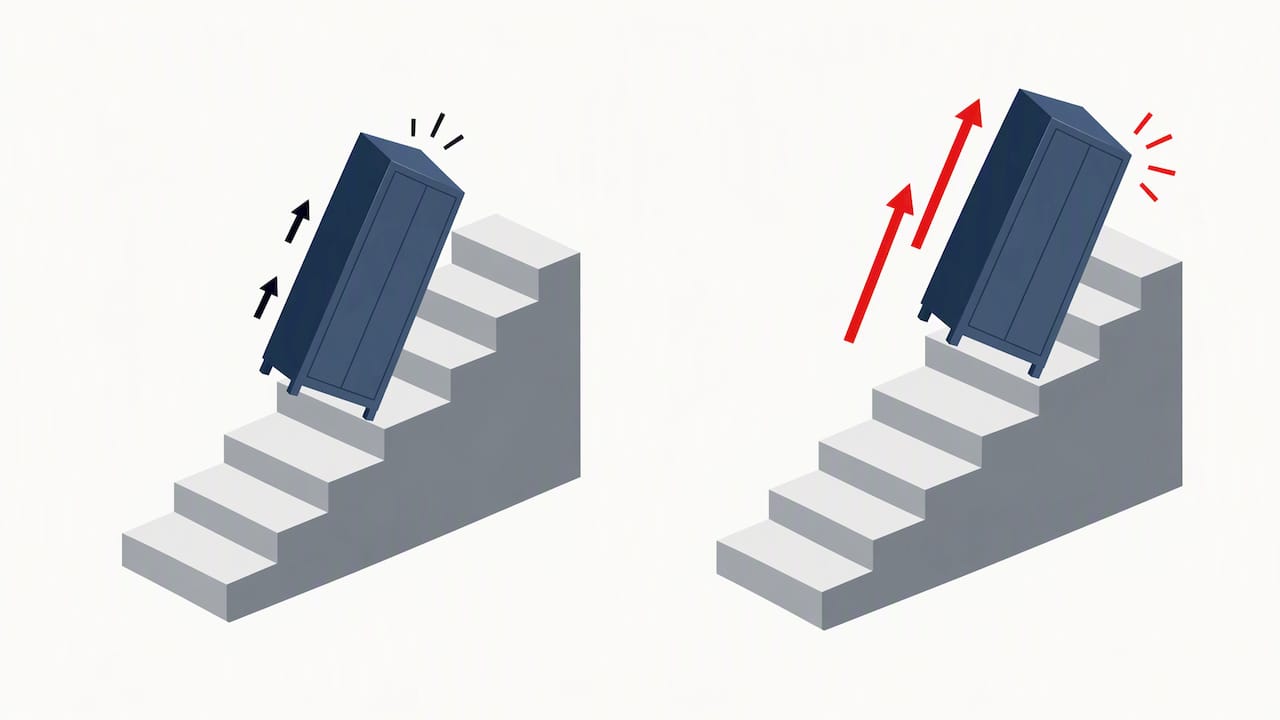
If you feel your lower back taking the strain rather than your legs, stop. Healthdirect’s guidance on back injuries advises against pushing through pain when moving heavy items, since sprains and strains from awkward lifts are common and best avoided with a conservative approach.
Most furniture that’s genuinely heavy, wardrobes, sofas, queen or king bed frames, needs two people working to a plan rather than two people guessing. Assign roles before you lift: a lead at the front who calls directions and watches the path, a tail at the back who takes cues and controls pace, and a spotter on tight stairwells who watches corners and calls out clearance.
Agree on simple verbal commands before you start, such as “lift”, “stop” and “turn”, and use them every time rather than relying on body language on a staircase where you can’t always see each other.
For common pieces:
Shoulder dollies or lifting straps redistribute weight from your arms and lower back to your shoulders and legs, which matters most on a staircase where you can’t set the item down easily mid-carry.
Landings are where most team moves stall. Plan the turn before you reach it: the lead stops, the tail holds position, and you rotate the item together on a count rather than each person adjusting independently. If the landing is too tight to rotate a wardrobe or sofa safely, that’s the point to stop and consider partial disassembly, removing doors, legs or shelving, rather than forcing a turn around a banister.
Pro Tip: Agree on a single “stop” command that everyone uses, and practise it once on flat ground before you’re on the stairs. A team that hesitates for even a second on a landing is more likely to drop a corner into a wall.
The right aid turns a two-person struggle into a controlled, repeatable process, but the wrong aid on the wrong staircase creates its own hazards.
Common options and where they fit:
Match the aid to the staircase, not just the item. A stair-climbing dolly needs consistent riser height and a reasonably wide tread to track safely, a carpeted staircase changes how a dolly’s wheels grip compared to timber, and a tight landing may not give a powered climber enough room to reposition between flights. WorkSafe’s detailed guide on handling large, bulky or awkward items recommends labelling weights and grip points on bulky items and using mechanical aids wherever the geometry allows it, rather than defaulting to manual carrying.
Mechanical aids carry their own hazards: a stair-climbing dolly can overbalance on a steep flight, and straps under tension can crush fingers if they slip. A trained operator or a spotter watching the load’s balance point is what keeps these tools safe rather than risky, particularly on any staircase steeper than a standard domestic flight. For a deeper look at matching equipment to your specific move, our guide to essential equipment for heavy furniture moves walks through sizing and selection in more detail.
Corners and low headroom are where most stair moves actually fail, usually because nobody checked the diagonal measurement before committing to the lift.
Work through tight spots in this order:
Pro Tip: Cut a cardboard template matching your item’s tightest dimension and test it against the corner before you move the real piece. It costs you five minutes and saves you a damaged wall.
Before you commit to a DIY stair move, run through the same checks a professional crew would: assess the hazard, work out the best handling zone, decide what mechanical aids apply, and eliminate the hazard entirely where you can, by disassembling the item, removing doors, or changing the route. WorkSafe’s hazardous manual handling guide and the AFRA recommended industry standards both point to the same approach: measure first, protect the item and the property, and use mechanical aids before relying on manual carrying.
Several red flags mean it’s time to book professionals rather than push on:
Pre-move assessment is standard industry practice. AFRA’s recommended standards call for a walkthrough, route measurement and protective packing before any oversized or awkward item is moved, with professional handling recommended once an item exceeds what a crew can manage with standard aids.
If you do call a removalist, ask what mechanical aids they bring for stairs specifically, whether their quote includes insurance cover for the property and the item, and how they handle a staircase that turns out tighter than expected on the day. Our guide to hiring help for heavy furniture moves in Melbourne covers the questions worth asking before you book.
A removalist crew runs through a sequence most DIY movers skip entirely, and it’s worth borrowing even if you’re not booking a crew.
On the day, a professional approach typically includes:
Measure twice, wrap once, and never let the crew find out a corner is too tight while they’re holding the weight.
Coordinating a stair move well comes down to communication as much as muscle. A crew agrees on commands, confirms who’s carrying the heavier end, and checks in at every landing rather than assuming the plan from the ground floor still holds three flights up. That’s the same discipline worth applying to a DIY move with friends or family: agree on the plan before anyone picks anything up, not halfway up the stairs.
The honest answer is that most people overestimate what they can move safely and underestimate how quickly a stair move turns into a two-person job that needed four hands. I’d rather see someone measure properly, use the right strap or dolly, and move a genuinely manageable item than watch a well-intentioned DIY attempt turn a staircase into an obstacle course.
Try the DIY route when your measurements leave real clearance and you’ve got the right aid for the job. The moment an item’s size, weight or your stairwell’s geometry puts you in doubt, that’s not a sign to push through, it’s a sign to get a professional opinion before anyone gets hurt.
— Dinshaw
When a piece won’t cooperate with a tape measure and a strap, that’s exactly the situation our crews handle every week across Melbourne. We bring stair-climbing dollies, lifting straps and floor protection as standard, and our team handles the measuring, padding and route planning before anything leaves the ground floor.

For a straightforward stair move, our residential moving services cover everything from a single oversized wardrobe to a full house relocation, and we offer packing and unpacking if you’d rather we handle the fragile items too. When you book with us, expect:
Our packing and unpacking service is priced at $109 per hour, and other services including residential moves, storage and waste disposal are quoted once we understand your job. If you’re weighing up a DIY attempt against booking a crew, get in touch through our services page and we’ll give you a straight answer on whether your move needs professional hands.
Strap the item securely, tilt it onto its base edge rather than lifting it flat, and walk it up one step at a time using a single-person stair dolly if it’s a compact piece within reasonable solo handling weight. Stop if the item blocks your view of the stairs or shifts unpredictably when tilted, since that’s when a solo lift becomes unsafe.
Oversized items with an unpredictable centre of gravity, wardrobes, large sofas and pianos among them, cause the most difficulty on stairs because they’re hard to tilt or rotate safely through tight turns. Items that can’t be partially disassembled to reduce their footprint are often the ones that need a specialist crew.
Measure the couch’s diagonal dimension against the corner’s clearance before attempting the turn, then rotate it around a fixed pivot point rather than shuffling it sideways. Removing the legs and padding every contact surface with moving blankets reduces the chance of damage during the turn.
Measure the staircase width, riser height and any headroom restrictions first, then choose an aid, sliders for landings, a stair-climbing dolly for straight runs, that matches that geometry. If the measurements don’t leave clearance even after removing doors or shelving, a professional crew with the right equipment is the safer option.

No Related Post


