



Moving your home or office? Everyone knows shifting your life or your whole business can turn into a logistical nightmare. But here is the surprise. Australian businesses can reduce moving expenses by up to 35 percent just by planning the right way. That figure flips the whole story on its head because it means that understanding the real difference between residential and commercial moves could be the smartest decision you make, not just a necessary evil.
| Takeaway | Explanation |
|---|---|
| Understand moving types for tailored services | Recognising differences between residential and commercial moving helps choose the right service for specific needs. |
| Plan meticulously to minimize disruptions | Comprehensive planning is essential, especially for commercial moves, to ensure smooth transitions and operational continuity. |
| Focus on emotional sensitivity in residential moves | Residential moving involves personal items and must address the emotional complexities of relocating a home. |
| Utilize expert services for specialized needs | Professional movers offer expertise in handling sensitive equipment and logistical challenges specific to commercial relocations. |
| Risk management is crucial for commercial moving | Addressing operational risks and ensuring compliance during commercial moves can prevent significant financial losses. |
Residential and commercial moving are two distinct types of relocation services that cater to different needs, environments, and complexities. Residential moving involves transferring personal belongings and household items from one home to another, typically for individuals or families, while commercial moving focuses on relocating business assets, office equipment, and entire workplace environments.
While both types of moving services involve transportation of items, the scale, complexity, and approach significantly differ.
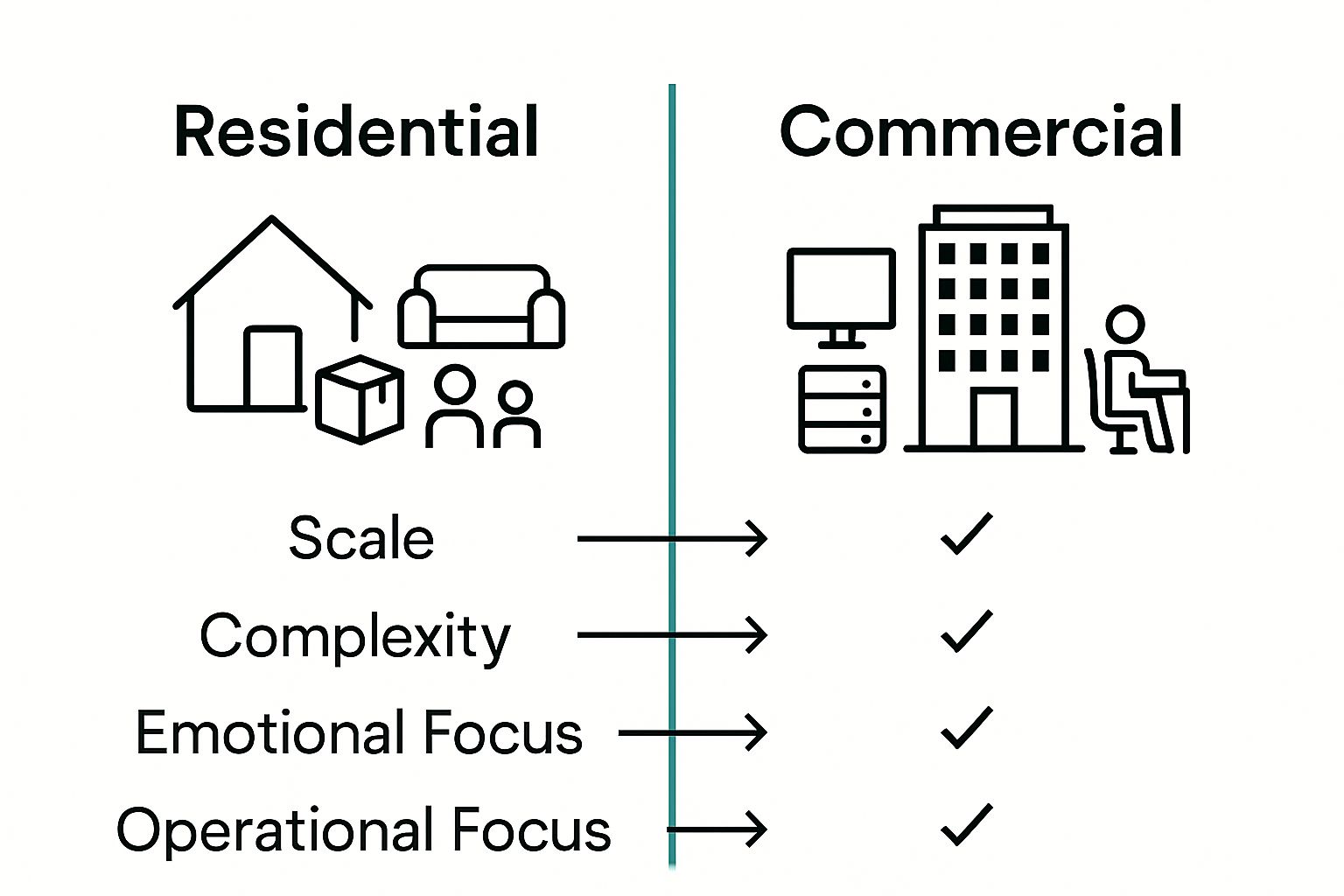 Residential moves usually involve personal items like furniture, clothing, kitchenware, and sentimental possessions. These moves are generally more emotionally charged and require a sensitive approach. Commercial moving costs can be substantially more complex, involving precise logistics, specialized equipment, and minimal disruption to business operations.
Commercial moving demands a higher level of professional expertise compared to residential relocations. Businesses require specialized handling for:
Residential moves, while still requiring professional skills, typically involve more standardized packing and transportation methods. Businesses often need detailed inventory management, precise timing, and minimal operational downtime during the move.
Understanding these fundamental differences helps individuals and organizations choose the right moving service tailored to their specific requirements, ensuring a smooth and efficient relocation process.
Below is a comparison table highlighting the main differences between residential and commercial moving in Australia, organised by key aspects discussed in the article.
| Aspect | Residential Moving | Commercial Moving |
|---|---|---|
| Primary Focus | Personal belongings and household items | Business assets, workplace equipment, office furniture |
| Emotional Considerations | High – sentimental items, emotional support needed | Lower – focus on operational continuity |
| Packing Requirements | Standardised, item-specific | Specialised, often technical or regulated |
| Scale & Complexity | Usually smaller and less complex | Larger scale, more complex logistics |
| Cost Structure | Predictable, based on volume and distance | Complex, impacted by downtime and equipment needs |
| Downtime Sensitivity | Typically not urgent | Minimising downtime is critical |
| Risk Management Focus | Item protection, personal comfort | Operational, technical, legal risks |
| Regulatory/Compliance Needs | Rare or low | Often essential (e.g. data security, compliance) |
Recognising the distinct nuances between residential and commercial moving is crucial for efficient, cost-effective, and stress-free relocation experiences. The approach, resources, and strategic planning required dramatically differ based on the type of move, making comprehensive understanding essential for both individuals and organisations.
The financial landscape of moving varies significantly between residential and commercial relocations. Residential moves typically involve predictable costs based on volume and distance, whereas commercial moves encompass complex pricing structures influenced by equipment specialisation, downtime minimisation, and intricate logistical planning. According to Australian Business Mobility Research, businesses can potentially reduce moving expenses by up to 35% through strategic planning and understanding their specific moving requirements.
Understanding moving differences is fundamentally about risk mitigation. Commercial relocations carry substantially higher stakes, where operational interruptions can translate into significant financial losses. Critical considerations include:
Each moving scenario demands a tailored approach. While residential moves focus on personal comfort and emotional support, commercial moves require precision, technical expertise, and strategic coordination. Professional moving services that comprehend these nuanced differences can provide targeted solutions that address unique challenges, ensuring seamless transitions for both households and businesses.
Residential moving represents a complex choreography of logistics, emotional management, and precise planning designed to transfer personal belongings safely and efficiently from one living space to another. Professional moving services transform what could be an overwhelming personal transition into a structured, manageable process.
Every residential move begins with a comprehensive initial consultation and assessment. Professional movers evaluate the volume of items, potential challenges in packing and transportation, and specific client requirements. Our comprehensive moving tips highlight the importance of detailed pre-move planning, which involves creating an inventory, determining packing strategies, and establishing a realistic timeline for the entire relocation process.
Packing represents a critical phase in residential moving that demands meticulous attention to detail. Professional moving teams employ specialized techniques to protect personal belongings, ensuring minimal risk of damage during transportation. Key considerations include:
The transportation phase involves carefully loading belongings, selecting appropriate vehicles, and executing a strategic route that minimises potential risks. Professional movers understand the nuanced requirements of residential moves, recognising that each item represents not just a physical object, but potentially a cherished memory or important personal possession. Successful residential moving goes beyond mere transportation it involves providing a supportive, stress-free experience that acknowledges the emotional complexity of changing living spaces.
Commercial moving represents a highly sophisticated and strategically complex process that goes far beyond simple transportation of office equipment. Professional commercial moving services orchestrate intricate logistical operations designed to minimise business disruption and ensure seamless operational transitions between workplace environments.
Successful commercial moves begin with an exhaustive preliminary assessment that examines every aspect of the organisation’s infrastructure and operational requirements.
This table summarises the core stages and focus points of residential and commercial moving processes as explained in the article.
| Stage/Phase | Residential Moving | Commercial Moving |
|---|---|---|
| Initial Assessment | Volume check, personal requirements | Infrastructure and operational analysis |
| Planning | Inventory, packing strategy, personal timeline | Custom strategy, inventory, technological review |
| Packing & Preparation | Standard packing, itemised labelling | Specialised equipment/IT packing, security focus |
| Transportation | Optimised for personal belongings | Phased logistical moves, minimal business impact |
| Delivery & Integration | Unpack and settle in home, emotional care | Post-move integration, minimise downtime |
| Comprehensive commercial storage solutions play a critical role in understanding the comprehensive scope of corporate relocations. Professional movers conduct detailed inventories, evaluate technological infrastructure, and develop customised moving strategies that address unique organisational needs. |
Commercial moving demands extraordinary precision and specialised technical capabilities. Unlike residential moves, commercial relocations involve transporting complex technological ecosystems that require expert handling. Critical components of this process include:
The actual moving process represents a meticulously choreographed operation where timing, precision, and minimal downtime are paramount. Professional commercial moving teams work collaboratively with organisational leadership to develop phased transition plans, often executing moves during off-peak hours or weekends to reduce potential productivity disruptions. The ultimate goal extends beyond physical transportation it involves facilitating a smooth, integrated transition that allows businesses to resume full operational capacity as quickly and efficiently as possible.

Understanding the unique requirements and complexities of residential and commercial moves is crucial for selecting the most appropriate moving strategy. Professional moving services must adapt their approach to address the distinct challenges presented by each type of relocation, ensuring optimal outcomes and minimal disruption.
Residential moves demand a nuanced approach that balances logistical efficiency with emotional sensitivity. Our comprehensive moving equipment guide highlights the importance of selecting appropriate tools and techniques for personal belongings. Key considerations include managing personal attachments, protecting sentimental items, and creating a supportive transition experience that acknowledges the emotional complexity of changing living spaces.
Commercial relocations require a strategic, precision-driven approach that prioritises operational continuity and minimal business interruption. Essential considerations encompass:
While both residential and commercial moves involve inherent risks, the nature and scale of these risks differ significantly. Residential moves primarily focus on physical item protection and personal comfort, whereas commercial moves must address complex operational, technological, and legal challenges. Professional moving services must develop tailored risk mitigation strategies that account for the unique vulnerabilities of each relocation type, ensuring comprehensive protection and seamless transition processes.
If you are feeling stressed about choosing the right moving solution or worrying about the challenges mentioned in this article, such as protecting sensitive business assets, keeping downtime low, or managing the emotional weight of a home move, you are not alone. The difference between residential and commercial moving is clear. So is the need for specialists who understand both worlds. Explore the key differences and how our business moving services are designed to tackle every pain point, whether you are relocating your office or your family home.
Now is the time to act. Let our Melbourne-based professionals create a tailored moving plan just for you. We offer personalised solutions for businesses and households, with every detail handled so you can focus on your priorities. Visit Onyx Removals today to get started or contact our team directly for your quote and experience a truly stress-free move.
Residential moving typically involves personal belongings and household items, while commercial moving focuses on business assets and workplace equipment. Identify your needs based on whether you’re moving a home or a business to determine the appropriate moving service.
To prepare for a residential move, create a comprehensive inventory of your items and outline a packing plan. Start packing non-essential items at least 3–4 weeks in advance to ease the transition.
For a commercial move, begin with a detailed assessment of infrastructure and operational needs. Implement a phased moving strategy to minimize downtime, allowing your business to continue functioning efficiently.
To ensure the safety of sensitive equipment, engage professional movers experienced in handling technological infrastructure. Clearly communicate the specific handling needs for electronics and confidential information to your moving team.
The cost of residential moving mainly depends on the volume of items and distance, while commercial moves involve more complex pricing due to equipment and downtime considerations. Get quotes from moving services that outline all potential costs to avoid surprises.
To choose the right moving service, assess whether your needs are more aligned with residential or commercial moving requirements. Compare services by their experience with your specific type of move, ensuring they can handle the unique challenges your situation presents.

No Related Post


