



TL;DR:
- Full service moving involves professional handling of packing, transportation, unpacking, and debris removal. It benefits families with large homes, long-distance needs, or fragile items by reducing physical and logistical risks. Families often underestimate the true costs and stress of DIY moves, making full service a more efficient option.
Full service moving is defined as a complete relocation service where professionals handle every physical and logistical task on your behalf, from packing your belongings to removing the last cardboard box from your new home. The industry term for this is “full service removal,” and it covers packing, loading, transport, unloading, unpacking, and debris removal under a single contract. For families and individuals planning a move in Melbourne, understanding what full service moving means is the first step toward choosing the right level of support. Onyx Removals delivers this complete package, tailored to residential and commercial clients across Melbourne.
Full service moving covers every step of your relocation, not just the truck and the driving. Professional packing with supplied materials is the starting point. Trained removalists arrive with boxes, bubble wrap, packing paper, and tape, then pack your entire home using techniques matched to each item type.
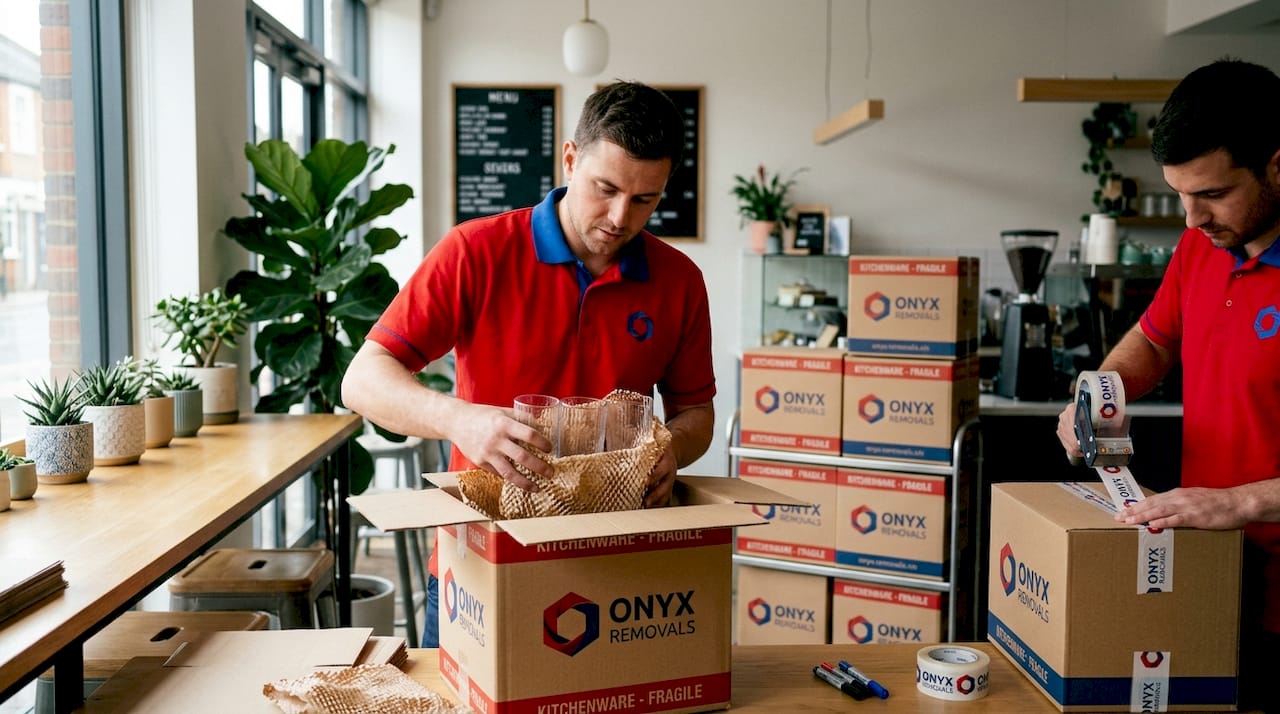
Professional packers use different methods for glassware, electronics, and antiques to reduce the risk of damage in transit. A fragile wine glass needs cell-divided boxes and double-wrapping. A flat-screen television needs custom foam inserts and an upright position in the truck. These are not details a DIY move handles well.
Before packing begins, a detailed pre-move inventory is compiled room by room. This document serves two purposes: it keeps the move organised, and it forms the basis of any insurance or damage claim if something goes wrong.
The full service process includes:
Protective equipment such as floor runners, corner protectors, and door-frame padding is standard on a professional move. These materials prevent scratches and scuffs that would otherwise cost you money to repair after the move.
Pro Tip: Ask your removalist to confirm whether unpacking is included in your quote. Standard unpacking means boxes are emptied onto flat surfaces, not that your kitchen will be organised for you.
Full service moving delivers the greatest value to people whose time, belongings, or circumstances make a DIY approach genuinely risky. Households with three or more bedrooms, long-distance moves, owners of fragile or high-value items, and full-time workers are the groups that benefit most. The common thread is that the cost of getting it wrong, whether in time, money, or damaged property, outweighs the cost of professional help.
Families moving from a large home carry the most physical risk with a DIY approach. Furniture is heavy, hallways are narrow, and a single dropped wardrobe can damage floors, walls, and the piece itself. A professional team with the right equipment removes that risk entirely.
People who benefit most from full service moving include:
Full service moving gives clients control over their time by delegating the labour-intensive tasks to professionals. That freed-up time lets you focus on work, family, and the practical side of settling into a new area, rather than spending a weekend exhausted and surrounded by half-packed boxes.
The core difference between full service moving and a DIY or partial move is who carries the risk and the workload. In a DIY move, you rent a truck, source your own packing materials, do all the packing and loading yourself, and manage transport. In a partial move, you might hire a truck and driver but pack everything yourself. In a full service move, the removalist owns every task.
DIY moves appear cheaper on the surface. The reality is different. Hidden costs of DIY moves include equipment rental, retail-priced packing materials, property damage repairs, and the value of your personal time. A scratched hardwood floor or a cracked wall panel from a poorly managed sofa can cost more to fix than the price difference between DIY and professional help.
Property damage during a DIY move is a common and underestimated expense. Professional removalists carry valuation coverage and liability insurance that protects your belongings during the move. A DIY move carries no such protection unless you arrange it separately, which most people do not.
| Factor | Full service move | DIY or partial move |
|---|---|---|
| Packing responsibility | Removalist handles all packing | You pack everything yourself |
| Equipment and materials | Supplied by removalist | You source and pay separately |
| Insurance coverage | Included via valuation coverage | Not included unless arranged separately |
| Risk of property damage | Minimised with protective gear | Higher without professional equipment |
| Time required from you | Minimal | Significant, often multiple days |
| Handling of specialty items | Trained professionals | High risk without specialist knowledge |
Pro Tip: When comparing quotes, ask each removalist to itemise what is and is not included. A lower quote that excludes packing materials and insurance is rarely the better deal once you add those costs back in.
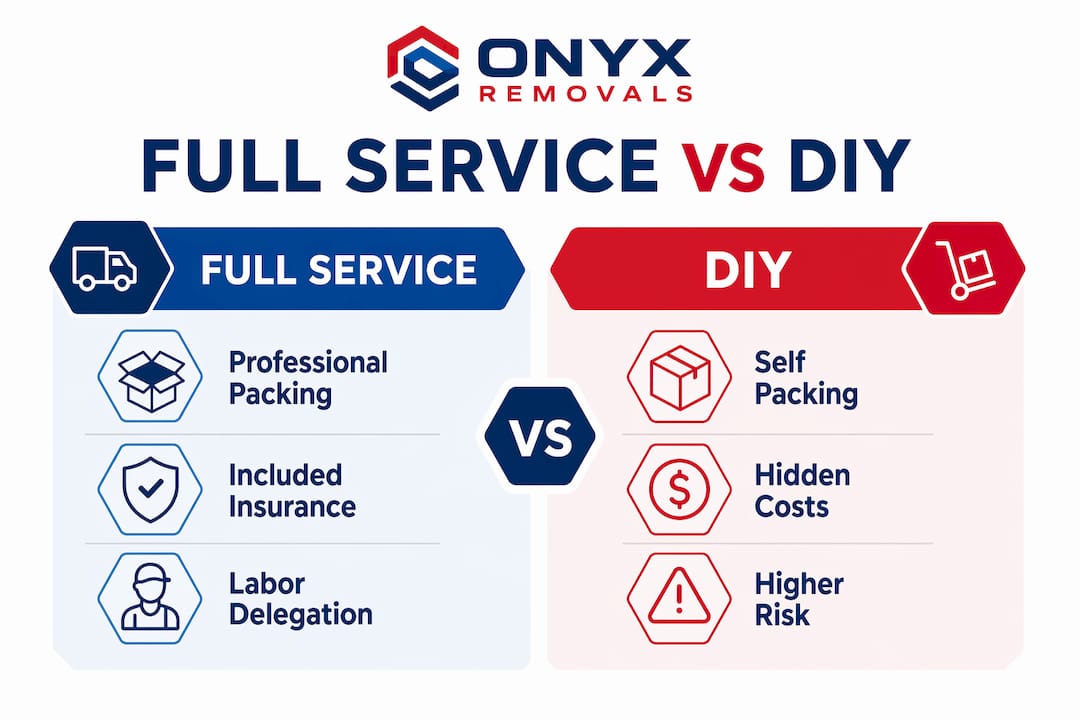
For more detail on professional packing versus DIY, the differences in outcomes are significant, particularly for larger homes and long-distance moves.
Several persistent myths stop families from choosing full service moving even when it suits their situation perfectly. Clearing these up helps you make a better decision.
“I lose control of my belongings.” The opposite is true. Professionals give clients control over scheduling and communication, freeing them from manual labour. You direct where furniture goes, you approve the inventory, and you set the timeline. The removalist executes your instructions.
“Unpacking means my home will be fully organised.” Standard unpacking means removing items from boxes and placing them on flat surfaces such as benches and tables. It does not mean your wardrobe will be sorted or your kitchen arranged. Concierge-level organisation is a separate, optional service.
“Full service moving is only for wealthy people.” Pricing reflects the scope of work and the risk mitigation involved. When you account for the hidden costs of a DIY move, including equipment hire, materials, and potential damage repairs, the gap between DIY and full service is often smaller than families expect.
“Professional movers will rush and break things.” Reputable removalists use floor runners, corner protectors, and door-frame padding as standard. Their business depends on delivering your belongings intact. Speed and care are not opposites when the team is trained and equipped.
“I have to be home the entire time.” You do not need to supervise every box. The pre-move inventory and a clear briefing at the start of the day give the team what they need. Many clients use moving day to handle other settlement tasks or spend time with their children.
For a closer look at what household goods insurance actually covers during a professional move, the details matter more than most families realise until something goes wrong.
Full service moving is the most complete and risk-managed way to relocate, covering packing, transport, insurance, and debris removal under a single professional arrangement.
| Point | Details |
|---|---|
| Complete service scope | Full service moving covers packing, loading, transport, unloading, unpacking, and debris removal. |
| Best suited for | Families in large homes, long-distance movers, and owners of specialty or fragile items benefit most. |
| Hidden DIY costs | Equipment hire, retail materials, and property damage repairs often close the price gap with full service. |
| Unpacking scope | Standard unpacking places items on flat surfaces; interior organisation requires a separate concierge service. |
| Insurance protection | Full service moves include valuation coverage and liability insurance not present in DIY moves. |
The families I speak with most often arrive with the same assumption: full service moving is a luxury for people with more money than time. After years working in the Melbourne removals industry, I find that assumption rarely holds up once you look at the numbers honestly.
The time cost of a DIY move for a four-bedroom home is real. Packing alone takes most families a full week of evenings and a weekend. Loading and unloading adds another day. Then there is the physical toll, the sore backs, the bruised doorframes, and the one item that gets dropped and breaks. None of that shows up in the truck hire quote.
What I have observed consistently is that families who choose full service moving arrive at their new home with energy left. They are not exhausted and irritable on day one. The children are less unsettled because the adults are less stressed. That is not a small thing when you are trying to make a new house feel like home quickly.
My honest advice is this: price it properly before you decide. Get a full service quote, then add up the real cost of doing it yourself, including your time at its actual value. For most families with a three-bedroom home or larger, the gap is smaller than expected, and the difference in experience is significant.
— Dinshaw
Onyx Removals provides residential moving services across Melbourne, covering every element of a full service move from packing and loading through to unpacking and debris removal. The team brings all materials, protective equipment, and the local knowledge that makes Melbourne moves run on time.
Whether you are moving a family home, a studio apartment, or need packing and unpacking support as a standalone service, Onyx Removals builds a plan around your schedule and your home. The team handles specialty items, storage arrangements, and interstate logistics with the same care as a local move. Contact Onyx Removals for a custom quote and find out exactly what your move will involve before you commit to anything.
Full service moving means a professional removalist team handles every task in your relocation, including packing, loading, transport, unloading, optional unpacking, and removal of packing debris. You direct the process; the team does the physical and logistical work.
Standard unpacking means removing items from boxes and placing them on flat surfaces such as benches and tables. It does not include organising drawers, wardrobes, or shelves unless you add a concierge service to your package.
For households with three or more bedrooms, long-distance moves, or specialty items, full service moving is generally worth the cost. Hidden DIY expenses including equipment hire, retail packing materials, and property damage repairs often reduce the price gap significantly.
Full service moving companies carry valuation coverage and liability insurance to protect your belongings during the move. This is not standard in DIY moves unless you arrange separate coverage before moving day.
Ask your removalist to itemise every service in writing before you sign. Confirm whether packing materials, unpacking, debris removal, and insurance are included, as these vary between providers and affect the total value of the quote.

No Related Post


