



TL;DR:
- A fixed-price move guarantees a total cost based on a clear scope, providing predictability and safety for long or large household moves. The quote covers specific inventory, route, and access conditions, but changes in scope can lead to additional charges, so detailed preparation and understanding of variation clauses are essential. Fixed-price options are ideal for complex, interstate, or long-distance moves, while hourly rates suit small, local, and straightforward jobs.
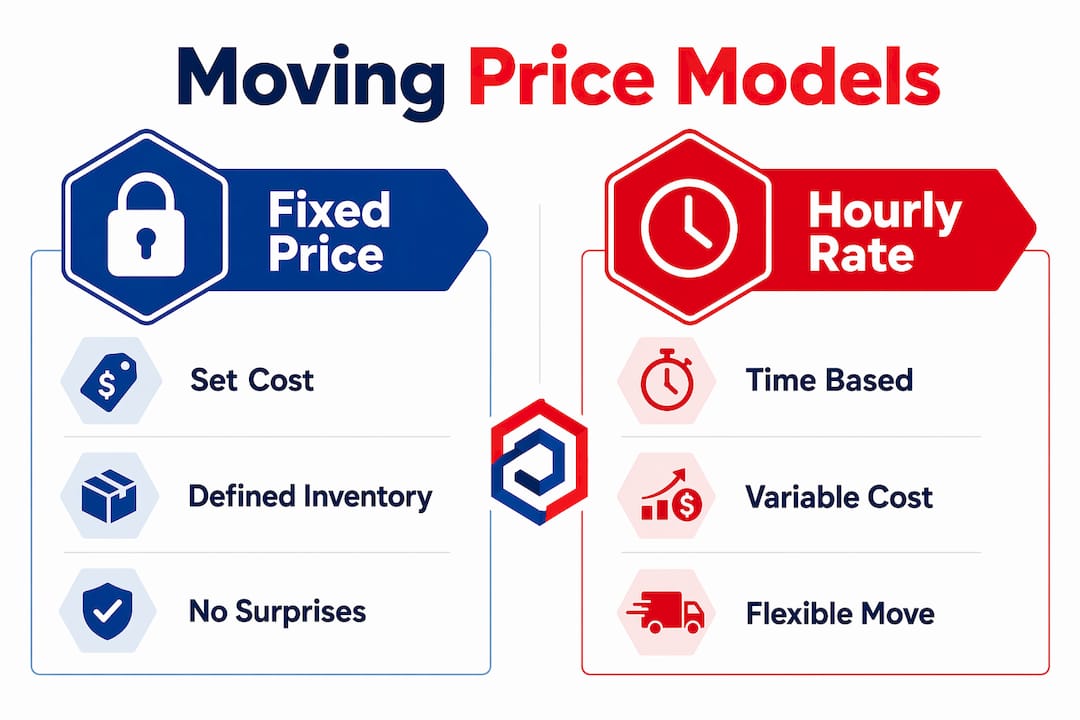
A fixed-price move is a single agreed total that covers a clearly defined scope of work. You pay that amount regardless of how long the job takes on the day. For most households moving interstate or shifting a full house locally, it is the safer, more predictable option — especially when budget certainty matters as much as the move itself.
Choose a fixed-price quote if:
A fixed quote is built from a defined scope, not a rough estimate. The removalist sets a price based on a specific inventory, a nominated route, and agreed access conditions at both ends. Change any of those elements and the price can change too, which is why the written quote matters so much.
Common inclusions:
Common exclusions:
The quote should come with a written inventory attachment and a variation clause. That clause is the contract term that governs what happens if the actual job differs from the brief. Always read it before signing.
Interstate moves are typically quoted as fixed prices based on volume, while local moves more commonly use hourly rates. Neither model is universally better. The right choice depends on how predictable your job is.

| Factor | Fixed price | Hourly rate |
|---|---|---|
| Cost certainty | Locked in upfront | Varies with actual time |
| When it tends to be cheaper | Large, complex, or long-distance moves | Small, simple, fast local moves |
| Typical inclusions | Crew, truck, fuel, basic wrapping | Crew and truck; extras billed separately |
| Risk of extra charges | Low if scope is accurate | Higher if job runs long |
| Best move types | Interstate, large households, complex access | Studio, one-bedroom, short local distance |
| Booking and timeline | Requires detailed inventory upfront | Can be arranged with less lead time |
Two quick examples:
Fixed pricing gives certainty and is often safer for full-household or long-distance moves, especially when the scope is stable. Fixed pricing gives certainty and is often safer for full-household or long-distance moves where the scope is stable. The scenarios below are where most households find it the better call.
Hourly pricing suits moves where the workload is short, visible, and unlikely to change. For well-prepared local moves where the scope is obvious, an hourly rate can save money.
If you go hourly, check these before booking:
A removalist builds a fixed quote by assessing every factor that affects labour and time. Knowing these helps you understand why two seemingly similar moves can have very different prices.
A fixed quote is only as accurate as the information you provide. Misrepresenting your inventory or access conditions is the most common trigger for costly variations on moving day.
Inventory checklist to prepare:
Access checklist for both addresses:
Questions to ask the removalist before signing:
For a detailed breakdown of what Onyx Removals asks for, the fixed quote requirements guide walks through every item.
Most moving-day disputes come from one source: a gap between what the removalist expected and what they found. These are avoidable.
Red flags to watch for:
Practical steps to protect yourself:
Pro Tip: If an unexpected access issue arises on moving day (a lift that is out of service, a parking restriction you did not know about), pause and ask the removalist to quote the variation before work continues. A five-minute conversation upfront is far less stressful than a dispute at the end.
Book 6–8 weeks in advance for standard moves and 8–10 weeks during peak periods such as end-of-month, school holidays, and summer. Last-minute bookings can attract premiums of 20–40% above standard rates.

Budget with a 10–15% contingency buffer on top of your fixed quote. Unexpected costs appear in almost every move.
The removalist quote is often less than half the real total cost of moving. Plan the full stack:
Local moves in Australia usually cost several hundred to over a thousand dollars, while interstate moves generally cost more depending on distance and volume. These figures cover the removalist only. The full moving stack is almost always higher.
A fixed-price move gives you a locked total for a defined scope, making it the right choice when your inventory, access, and dates are clear and budget certainty matters.
| Point | Details |
|---|---|
| Choose fixed price for complex moves | Large households, interstate moves, and known complex access benefit most from a fixed quote. |
| Prepare a complete inventory | Accurate room-by-room lists and access details are what make a fixed quote reliable and dispute-free. |
| Read the variation clause | Confirm how variations are calculated before signing — per item, per hour, or a fixed uplift. |
| Budget the full moving stack | The removalist quote is often less than half the total; include bond, cleaning, supplies, and a 10–15% buffer. |
| Onyx Removals fixed quotes | Onyx Removals provides written fixed quotes with inventory attachments and clear variation terms for Melbourne and interstate moves. |
The conventional wisdom is that a fixed quote protects you from bill shock. It does, but only if the information you give the removalist is accurate. The quote is a contract built on your description of the job. If that description is incomplete, the variation clause kicks in, and the protection you thought you had disappears.
The clients who end up in disputes are rarely the ones who lied. They are the ones who forgot to mention the piano in the study, assumed the lift would be available, or did not realise the truck could not park within 50 metres of their building. These are honest oversights, but they cost real money.
At Onyx Removals, the most useful thing an experienced removalist does is ask the questions clients do not think to answer. A proper pre-move survey or a structured inventory conversation surfaces the details that matter. The written scope that comes out of that process is what makes a fixed quote genuinely fixed. Skipping that step to save time is where most moving-day surprises are born.
Onyx Removals takes the guesswork out of fixed-price moving in Melbourne and interstate. Rather than a rough online estimate, Onyx builds each quote from a detailed inventory and access assessment, so the price you agree to is the price you pay. The written quote includes a clear variation clause, so you know exactly what would trigger a change and how it would be calculated.
Optional packing, unpacking, and transit insurance can be added to any fixed quote. Specialty items like pianos and pool tables are itemised, not buried in a vague total. To get started, have your room-by-room inventory and access details ready, then request a residential removal quote directly through the Onyx Removals website. You can also secure an accurate home removal quote by submitting photos and access notes for a more precise fixed total.

No Related Post


